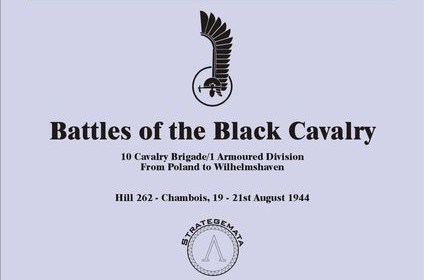
Battles of The Black Cavalry: A Boardgaminglife review

Some readers may recall an article I wrote for this site around fifteen months ago featuring another game by the same company, Festung Breslau.  That design covered the 1945 siege of the German city, in which Polish forces under Red Army command played a far from insignificant role.  My review was very largely positive, given the character of a relatively simple system in relation to the nature of a bitter street fight that lasted throughout the last months of the war in Europe.

Now, the same designer, Adam Niechwiej, has approached a very different subject, one that presents Polish forces fighting alongside the Western Allies in the struggle to close the Falaise Pocket.  This is, arguably, one of the most controversial episodes from the 1944 campaign – many believe that no German forces should never have been allowed to leach out the pocket and thus live to fight another day. 

Festung Breslau: A BoardgamingLife Review of Strategemata’s Game of Hitler’s Fortress City Under Siege

For me, one outstanding aspect of this design is the way its author has modeled two rather different armies fighting over a large expanse of city.  This was, of course, something John Hill sought to do in his Stalingrad design from 1980 – units from two forces that have much the same sort of information on them, but behave differently once they start moving and fighting on the game map.  In a very deft way, I believe Adam Niechwiej has bedded both forces into the battle environment, creating a distinct character for each of them in a relatively brief set of rules.  In play, the experience of commanding either the Soviets or the Germans will feel very different, and for reasons beyond the Soviets having this or that number of units or the Germans simply (one might erroneously assume) being outnumbered.

Bridges Close and Far: Arnhem 44

We’ve played lots of Arnhem games over the years and this had some clever mechanisms. We liked the simplicity of terrain To Hit numbers, even if units tended to act identical. The intrusion attacks are an interesting effort to insert a version of an overrun attack into an area game. Blowing up bridges, or diffusing explosives, adds a nice tension to the pace.

Moscow ‘41 – A Boardgaming Life Review

This game gives and it takes away.  What do I mean?  Well, just by looking at the map and the full game’s very first impulse pairing, we see that the German player has a great deal he or she can feel pretty superior about…only it all comes with subtle or blatant provisos, limitations, hindrances…as well as enraged Russians or partly bewildered Russians getting in the way.

1 2 3 4 5